Why your AI chatbot should be allowed to say "I don’t know"
 Johnny BuiAug 7, 20265 min read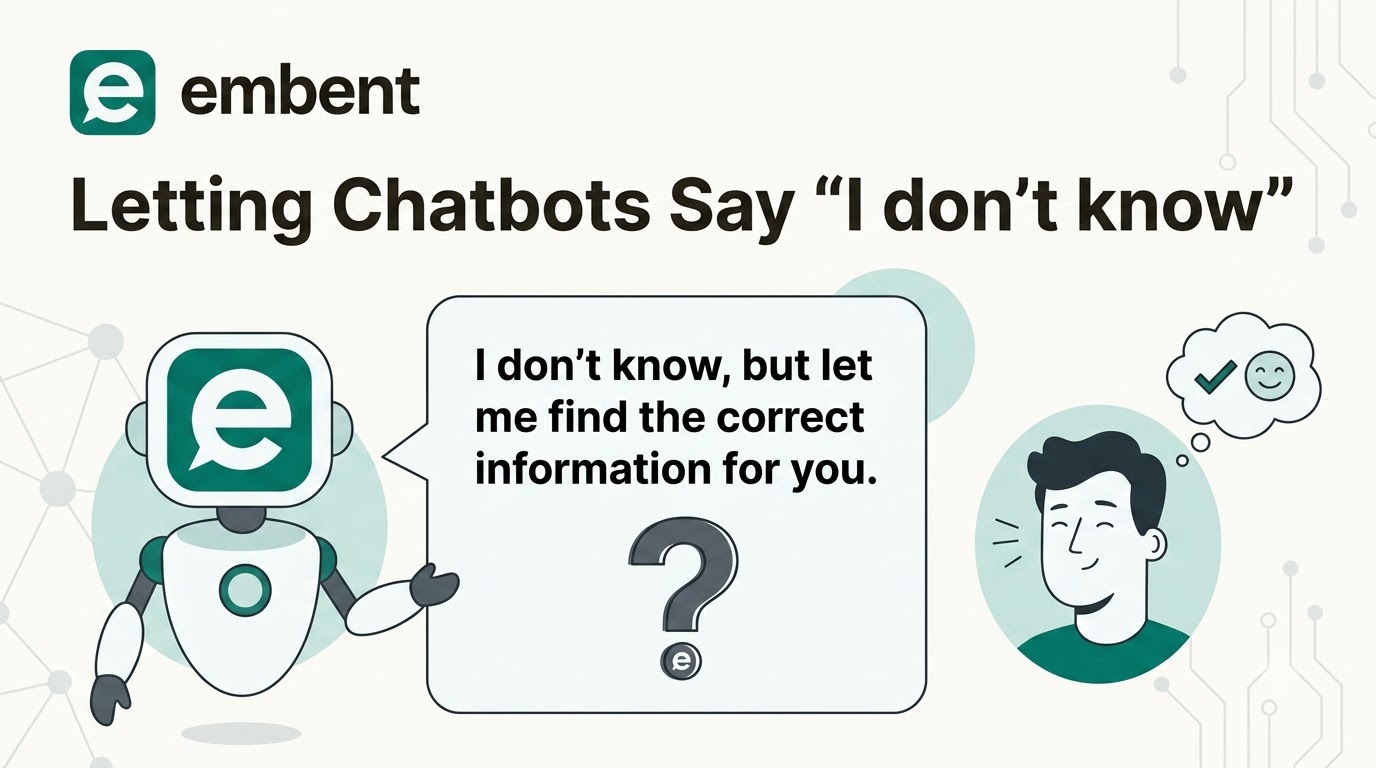
Most AI chatbots are built to always have an answer. Ask one a question its training never covered and it will still produce three confident paragraphs, because producing text is the only thing it knows how to do. On a consumer toy that is a party trick. On your company's website it is a liability with your name on it.
The failure nobody sees until a customer does
A support bot that invents an answer does not fail loudly. There is no error page, no alert, no red line in a dashboard. There is a visitor who read something plausible, believed it, and acted on it.
The shapes this takes are depressingly ordinary:
- A shipping policy that sounds right but describes a different company's terms.
- A refund window of 30 days when yours is 14.
- An integration that "works out of the box" and does not exist.
- A price that was true two funding rounds ago.
Each one produces the same sequence: a happy visitor, then a support ticket, then an apology, then — if you are unlucky — a screenshot on social media. The bot you installed to reduce support load has become a source of it.
Why it happens: the model was never asked to be accurate
A language model predicts likely text. Left to itself, "likely" and "true" overlap most of the time and diverge exactly when it matters: on your specific policies, your specific prices, your specific product.
There are two common ways to close that gap, and only one of them can say "I don't know."
Fine-tuning bakes your content into the model's weights. The model gets better at sounding like you, but the knowledge is now diffuse — smeared across billions of parameters with no address you can point at. Ask about a policy you changed last week and the model has no way to know its memory is stale, and no way to tell you it is guessing.
Retrieval keeps your content outside the model. Every question triggers a search over your actual pages; the passages that come back are handed to the model along with an instruction: answer from these, and only these. Now there is a checkable fact at the centre of the process — either the search found relevant content or it did not.
That difference is what makes honesty possible. A retrieval system knows when it came back empty. A fine-tuned model has nothing to notice.
"I don't know" is a feature, and it needs a threshold
Retrieval alone is not enough, because search always returns something. Ask a coffee shop's bot about mortgage rates and it will dutifully surface its three least-irrelevant pages. Feed those to a model told to answer from context, and it will construct something out of them.
The missing piece is a score threshold: a line below which retrieved content is treated as not good enough, and the honest answer is refused rather than assembled. Under the threshold, the right response is a short, useful admission:
I couldn't find anything about that in this site's content. Try rephrasing, or contact the site owner directly.
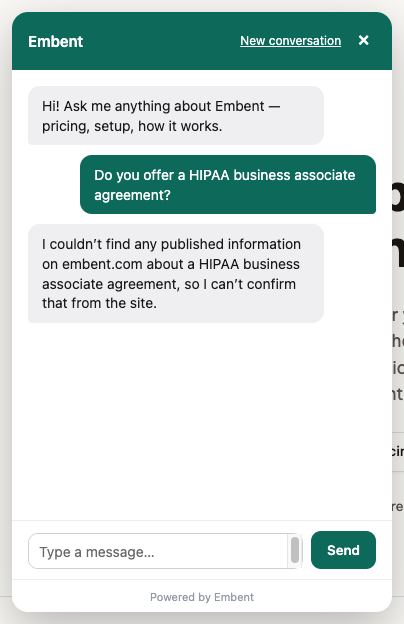
That sentence costs one visitor a moment of mild disappointment. The alternative costs you a support ticket and a little of your credibility.
Citations turn trust into something checkable
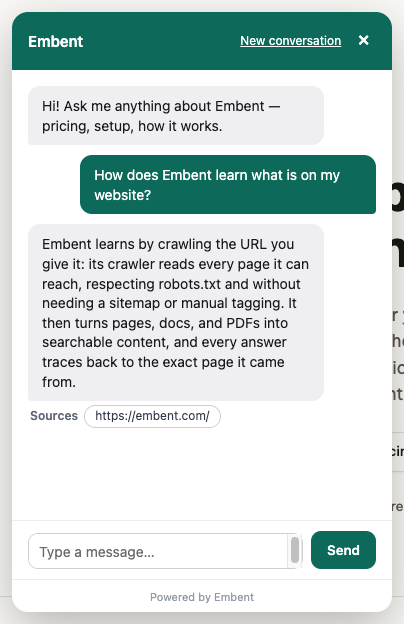
Once answers come from retrieved passages, every claim has a source — so show it. A link under each answer does three jobs at once:
- The visitor can verify. Trust stops being something you assert and becomes something they can click.
- You can audit. When an answer looks wrong, the citation tells you whether the bot misread the page or the page itself is wrong. Those are different bugs with different fixes.
- It disciplines the system. A pipeline that must produce a source for every claim cannot quietly wander off into invention.
An answer without a source is an opinion. An answer with one is a quote.
The questions it refuses are your most valuable data
Here is the part most teams miss. Every "I don't know" is a visitor telling you, in their own words, about a gap in your content — for free, unprompted, at the exact moment they needed it.
Logged and grouped, those refusals become the most honest content backlog you will ever have. Not what you assume people want to know. What they actually asked, ranked by how often they asked it.
The loop is short and it compounds:
- A visitor asks something your site does not answer.
- The bot declines honestly and logs the question.
- You write the missing page — or fix an unclear one.
- The next visitor with that question gets a real answer, with a citation.
A bot that invents answers cannot participate in this loop at all. It has nothing to report, because as far as it knows, it answered everything perfectly.
What to ask before you install one
If you are evaluating an AI agent for your site, these four questions separate the honest ones quickly:
- Where do answers come from? If the answer is "the model," ask what happens when your content changes.
- What happens when it finds nothing? If there is no refusal path, every question gets an answer whether or not one exists.
- Can I see the source of an answer? No citation, no audit trail.
- What do you do with the questions it can't answer? If they vanish, you are throwing away your best content research.
The honest bot wins on the metric that matters
It is tempting to judge a support bot by how many questions it answers. That number is easy to inflate — just remove the ability to decline.
The number worth tracking is different: how many answers were grounded in your real content, and how quickly the ungrounded ones turned into new pages. A bot that answers 80% of questions correctly and admits the other 20% is worth more than one that answers 100% with an unknown error rate, because only the first one tells you where you stand.
That is the whole design philosophy behind Embent: read your site, cite every answer, refuse rather than invent, and hand you the list of what you should write next.